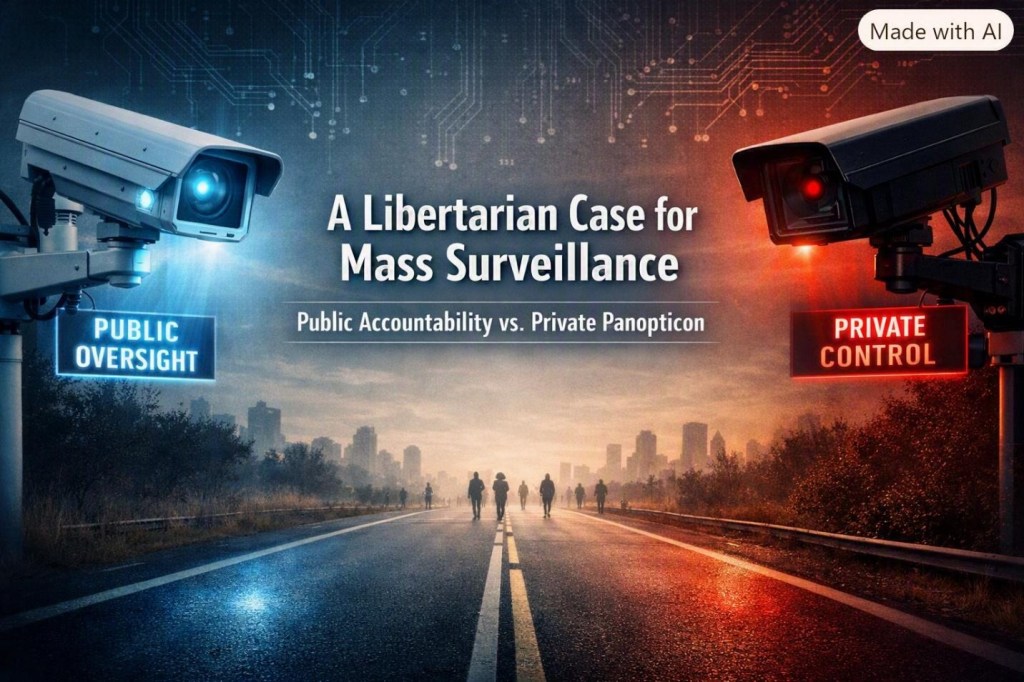
Your humble correspondent has known many people who were victims of crimes that went unavenged due to the state’s monopoly on law enforcement and claims by police that they lack evidence for those crimes on public roadways. And so, eternally optimistic, my first attitude toward the Flock cameras was that they might finally force the police to do their damn jobs. That is generally what happens to government with new advances in technology, right?
“WRONG!” I can already hear the chorus of libertarian execrations. “THINK AGAIN, BOOTLICKER!” I’m sure many a pink-haired autist will shriek from their keyboards. The pushback among fellow liberty lovers has provoked much internal pondering of this issue, and I have come around to seeing Flock as it currently exists (and within the hands it currently rests) as more of a threat than benefit to citizens. I’ve seen excellent arguments on both sides, though in terms of quantity the criticisms of mass surveillance in general have far outweighed those in support of it within the libertarian sphere. So, ever the contrarian, I will use this article to flesh out my gut reaction to Flock and address the concerns of libertarians as I see them — by articulating a libertarian steelman for mass surveillance of public spaces.
“This will be a tool for mass surveillance.”
I’m sure these same liberty-loving lolberts support body cameras for police and the rights of First Amendment auditors filming whatever they can see from public. “Can’t trespass my eyes,” is what you’ll hear many of them quote the Supreme Court on — and rightly so. Yet it appears those same people feel some kind of entitlement to privacy in the public square themselves. Would that not cede ground to the Karens and Darens of the Post Office in their eternal struggle against citizen journalism and public accountability?
“But United States v. Jones (2012) says it’s unconstitutional!”
Agreed, there have been Supreme Court precedents against tracking the movements and whereabouts of individuals without a warrant, but that is a separate argument from surveillance itself. After all, we already have cameras within every government building. Is merely documenting what happens on public property the same as using facial recognition technology to identify, track, and build profiles on everyone in sight?
It seems to me that it’s not mere surveillance itself by the government that is unconstitutional, but the use of that surveillance to track citizens and build individual dossiers on them without a warrant. Therefore, for the purposes of this article, my steelman applies only to the surveillance itself — not its use in tracking.
“The government will just disable the feed and delete the records when it benefits them.”
The same was said when police body cameras were introduced, yet plenty of accusations have been retracted and cops caught committing crimes thanks to FOIA requests of their own and other officers’ footage. It’s not like public mass surveillance would replace existing private cameras; their widespread implementation would simply result in more evidence of crimes or tyrannical behavior than we currently have.
“Flock cameras will be used to stop the revolution!”
Are they really bringing about anything that doesn’t already exist in the free market? Everyone is already being tracked by private companies through their cell phones and credit cards. Plenty of homes and businesses already have their own cameras — they just aren’t required to maintain them or make their records subject to FOIA. Currently, Flock and other ALPR records are also private, but it doesn’t have to stay that way, and maybe making these surveillance systems public is a better use of our energies.
Mass surveillance already exists. It is simply privatized, decentralized, unregulated, and therefore unaccountable to the public.
WWFMD – What Would the Free Market Do?
Libertarians often treat surveillance as inherently statist, but this conflates several distinct concepts into one. When we separate them, we find that multiple core libertarian principles actually support public-space documentation — provided it is constrained, transparent, and non-profiling.
If the state claims ownership of roads, parks, and public buildings, then it inherits the same obligations any private owner would have: to maintain safety, document incidents, and provide evidence when harm occurs. This imposes an inherently contractual nature onto all interactions on public property, surveillance of which is needed to provide evidence that those contracts are being rightly enforced. Public surveillance only becomes anti-libertarian when done without public accountability — which is precisely the case with private companies.
Privatized mass surveillance would be fine if all property it surveilled were also privatized, decentralized, and unregulated by the state. But that is not the reality. Public utilities — and therefore access — are practically forced upon everyone by the state. And it’s entirely possible that almost 1 in 7 people in the U.S. is an illegal immigrant, unvetted and unauthorized to access public property collectively owned and maintained by citizens’ taxes, much less the private property directly owned by said citizens, who have a reasonable expectation that their property should be secured against unvetted invaders within national borders.
On top of that is the recent trend of judges letting violent repeat offenders walk free. As the saying goes, sympathy to the wolf is cruelty to the sheep. This is especially true considering that, through the public square and positive forced-association rights enforced upon the public by the state, citizens have no freedom to completely disassociate themselves from violent individuals the state has unleashed upon the citizenry and legally prevents them from taking action against.
Would the free market tolerate such encroachments of ungoverned premises by any private business? Were a private company afforded continuous access to my property, it would have a legal duty to secure that access so it couldn’t be exploited by bad actors. Any harm against me performed by violent individuals by means of the private company’s access would thereby make the company itself an accomplice.
At what point does the lack of surveillance and basic security provisions in and of itself become a harm against the public? Especially given that the U.S. government has appointed itself an international police force and made enemies of the world, its invitation of displaced and disgruntled masses within its borders — both legally through refugee resettlement and illegally through lack of border enforcement — can itself be seen as extreme negligence toward existing American citizens. But even without such a ridiculous state of affairs, surveillance is a basic necessity for any private company.
How many Americans die every day on public roads? Roughly 40,000 annually. Were the roads owned by a private company, it would have been sued into oblivion for such a death toll if it lacked evidence proving those deaths were caused by misuse rather than infrastructure deficiencies. So is the lack of public road surveillance not itself a flex of government power against the people — a state-enabled deprivation of evidence of physical harms that would otherwise have been documented by a private company to establish liability?
The Gun in the Room – to Wield Or Be Wielded Against
Additionally, one might argue that fighting against advances in technology — and all exercises of power in general — is to effectively cede control of them to your enemies. Would it not better serve right-wing libertarians to fight for control of mass surveillance rather than against its inevitable existence? Would we rather not have mass surveillance to which the public can at least claim a right to access and control, rather than delegating that inevitable state of affairs to private companies whose fiduciary duties belong to shareholders rather than the public? Do those shareholders really have the public’s best interests in mind over their own pocketbooks?
I’m not saying the government necessarily does either, but at least it is in theory owned by the public, and the citizenry thereby has a rightful claim to its control. With private companies, the public does not even have that.
Furthermore, a lack of Flock cameras does not equate to a lack of public surveillance and tracking. Flock may be the company making headlines, but Axon, Motorola’s Vigilant Solutions, Rekor, and many more already have government contracts. These companies are learning from the pushback and implementing surveillance in more covert ways, such as integrating ALPRs into municipal street lights and highway overpasses.
Like with cell phone data, police may legally be required to get warrants to access this private information, and parallel reconstruction may technically be illegal — but we already know it happens every day and is extremely hard to prove. Would it not be better to have a publicly owned system of cameras, so people can be explicitly aware they’re being surveilled and have an actionable right to that evidence for their own defense?
Cast It Away? Why Not Use It?
In the eyes of this author, the main issue with Flock and other forms of existing mass surveillance is that they’re surveilling public spaces with privately owned technology and data. This enables police and federal agents to covertly use existing surveillance to accuse people of crimes using evidence the accused may not even be aware of — even after the accusations are made. Why not argue for public control of mass surveillance instead of opposing its existence entirely?
Instead of chopping down Flock camera poles and railing against all public mass surveillance, libertarians could be pushing for public ownership and accountability of these systems — laying the groundwork for reforms that prevent their use for tyrannical purposes. We could argue for immutable public access logs and civilian oversight boards so everyday citizens can monitor the systems for abuse. We could push for laws requiring mandatory access to those logs for defendants, so they can search not only for evidence police bring against them but for additional footage that might prove their innocence.
We might even establish rights and platforms wherein all citizens can access real-time public surveillance footage for whatever reason, replacing a private panopticon with a public omniopticon where all can observe one another’s actions in public, a true expression of our collective ownership of the public square. We could be like those adorable bears whose activities are continuously streamed on the Katmai live cams for all to see, viewers chatting and voting on each other’s fatness rankings and everything. Would you not be entertained?
Furthermore, in the interests of limiting mass surveillance, libertarians could argue for restrictions on facial recognition software, shorter retention limits, and against automatic dossiers documenting the movements of all citizens. The true danger is not as much in surveillance itself as in its mission creep — the gradual expansion of surveillance into tracking, profiling, and automated enforcement. This is why libertarians must demand hard limits on what surveillance can do, and the only way to truly enforce those demands is to make surveillance a public good over which citizens can exercise control.
Instead of denying the power of mass surveillance and ceding it to potential enemies, we could take control and wield that power for our own benefit through public oversight and regulation.
Conclusion
The question before us is not whether mass surveillance will exist. Mass surveillance already exists, and its expansion from private to public spaces is inevitable. The real question is: to whom will that surveillance be beholden? Who will be watching the watchers?